Rapidly increasing global nuclear energy capacity would involve significant challenges

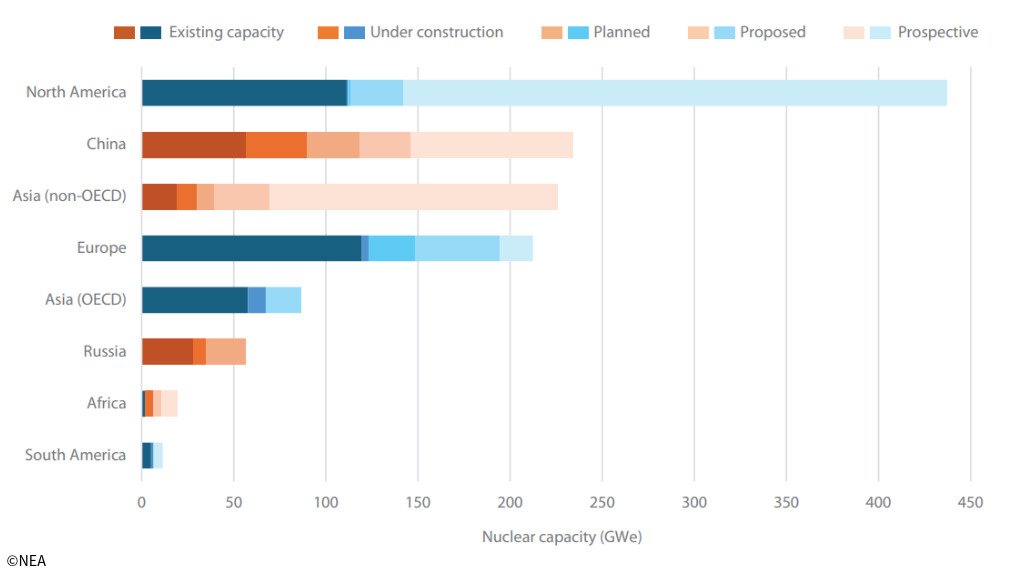
Nuclear capacity under construction, planned, proposed, and prospective by region
Photo by NEA


The Nuclear Energy Agency (NEA), an entity of the Organisation for Economic Cooperation and Development (OECD), has cautioned that successfully fulfilling global ambitions to significantly increase the quantity of nuclear energy will necessitate a major acceleration in the increase of the nuclear workforce, available finance and supply chains. This is the assessment contained in its new report, 'Nuclear Energy Outlook: Global Installed Capacity to 2050 and Beyond'.
For decades, the development of nuclear energy suffered from inaction on the part of OECD States, it points out. But now, an increasing number of both OECD and Global South countries are viewing nuclear energy as a key means of achieving energy security, environmental and industrial competitiveness goals.
The NEA report considers four scenarios for how global nuclear energy could develop from now until 2050, and beyond. These scenarios take into account new construction of both large (gigawatt-scale) nuclear power plants (NPPs) and small modular reactor (SMR) NPPs, and the refurbishment and long-term operation (LTO) of existing NPPs. These are dubbed the low, the current trends, the ambitious and the transformative scenarios.
Under the low scenario, global nuclear generation capacity would only reach 347 GWe by 2050. This would be the case if the recent momentum for nuclear power failed to become sustained development and if the retirement of NPPs in OECD countries offset new NPP projects.
The current trends scenario would see global nuclear capacity reach 619 GWe. This expansion would largely be driven by planned and proposed projects in non-OECD countries.
The ambitious scenario would result in global nuclear capacity totalling 883 GWe by 2050. This would involve a greater contribution from new-build large and SMR NPPs.
The transformative scenario would see global nuclear capacity more than tripled, to 1 324 GWe. This would be driven by long-term nuclear energy projects, in countries such as the US (aimed at increasing its nuclear capacity four-fold) and India (targeting 100 GWe of nuclear capacity by 2047), accelerated new construction of large NPPs, significant deployment of SMRs, and successful LTO of existing NPPs. But to achieve this scenario in OECD countries would need significant changes in government policies and in project implementation and financing as well as industrial capability.
Meanwhile, the geographic centre of nuclear power is shifting, the NEA notes. While about 78% of current global nuclear capacity is in OECD countries, some 80% of the 70 GWe currently under construction is in non-OECD countries. The biggest single-country new construction programme is China’s, totalling more than 33 GWe.
“In many OECD countries, limited new build over the past 25 years has weakened industrial capabilities and project delivery experience,” pointed out the NEA. “Meeting this challenge will require close cooperation between like-minded countries, stronger industrial partnerships and a shift from project-by-project approaches to programme-based deployment.”
LTO of existing NPPs is essential to achieve global nuclear capacity objectives. In OECD countries, many reactors would reach the end of their initial operating licences before 2040. Lengthening their lives to 60, or even 80, years would underpin energy security, retain dependable low-carbon generation, and ensure that there is no need for short-notice replacement of large amounts of secure generation capacity. However, at this time, more than 50 GWe of OECD nuclear capacity has not yet secured the licences needed for LTO until 2040.
Financing will be decisive to allow the expansion of nuclear power, worldwide. Currently, global capital expenditure on new nuclear capacity is running at some $30-billion a year, largely driven by China and Russia. This will have to increase “sharply” to enable the higher deployment scenarios.
“For OECD countries, annual capital requirements would need to increase from about $12-billion per year over the last decade to an average of $68-billion in the ambitious scenario and $143-billion in the transformative scenario. During the 2030s, the transformative scenario could see OECD capital requirements approach $200-billion per year. Given fiscal pressures on budgets, mobilising private capital will be essential. This will require bankable project structures, clear risk allocation, credible revenue models and government-backed mechanisms that reduce construction, market and political risks.”
Article Enquiry
Email Article
Save Article
Feedback
To advertise email advertising@creamermedia.co.za or click here
Research Reports

Projects
Latest Multimedia

Latest News
Showroom
AxFlow AQS Liquid Transfer (Pty) Ltd is an Importer and Distributor of Pumps in Southern Africa
VISIT SHOWROOM
CSIR International Convention Centre (CSIR ICC) - the leading conference and events venue in Pretoria/Tshwane.
VISIT SHOWROOM

Press Office
Announcements
What's On
Subscribe to improve your user experience...
Option 1 (equivalent of R125 a month):
Receive a weekly copy of Creamer Media's Engineering News & Mining Weekly magazine
(print copy for those in South Africa and e-magazine for those outside of South Africa)
Receive daily email newsletters
Access to full search results
Access archive of magazine back copies
Access to Projects in Progress
Access to ONE Research Report of your choice in PDF format
Option 2 (equivalent of R375 a month):
All benefits from Option 1
PLUS
Access to Creamer Media's Research Channel Africa for ALL Research Reports, in PDF format, on various industrial and mining sectors
including Electricity; Water; Energy Transition; Hydrogen; Roads, Rail and Ports; Coal; Gold; Platinum; Battery Metals; etc.
Already a subscriber?
Forgotten your password?
Receive weekly copy of Creamer Media's Engineering News & Mining Weekly magazine (print copy for those in South Africa and e-magazine for those outside of South Africa)
➕
Recieve daily email newsletters
➕
Access to full search results
➕
Access archive of magazine back copies
➕
Access to Projects in Progress
➕
Access to ONE Research Report of your choice in PDF format
RESEARCH CHANNEL AFRICA
R4500 (equivalent of R375 a month)
SUBSCRIBEAll benefits from Option 1
➕
Access to Creamer Media's Research Channel Africa for ALL Research Reports on various industrial and mining sectors, in PDF format, including on:
Electricity
➕
Water
➕
Energy Transition
➕
Hydrogen
➕
Roads, Rail and Ports
➕
Coal
➕
Gold
➕
Platinum
➕
Battery Metals
➕
etc.
Receive all benefits from Option 1 or Option 2 delivered to numerous people at your company
➕
Multiple User names and Passwords for simultaneous log-ins
➕
Intranet integration access to all in your organisation